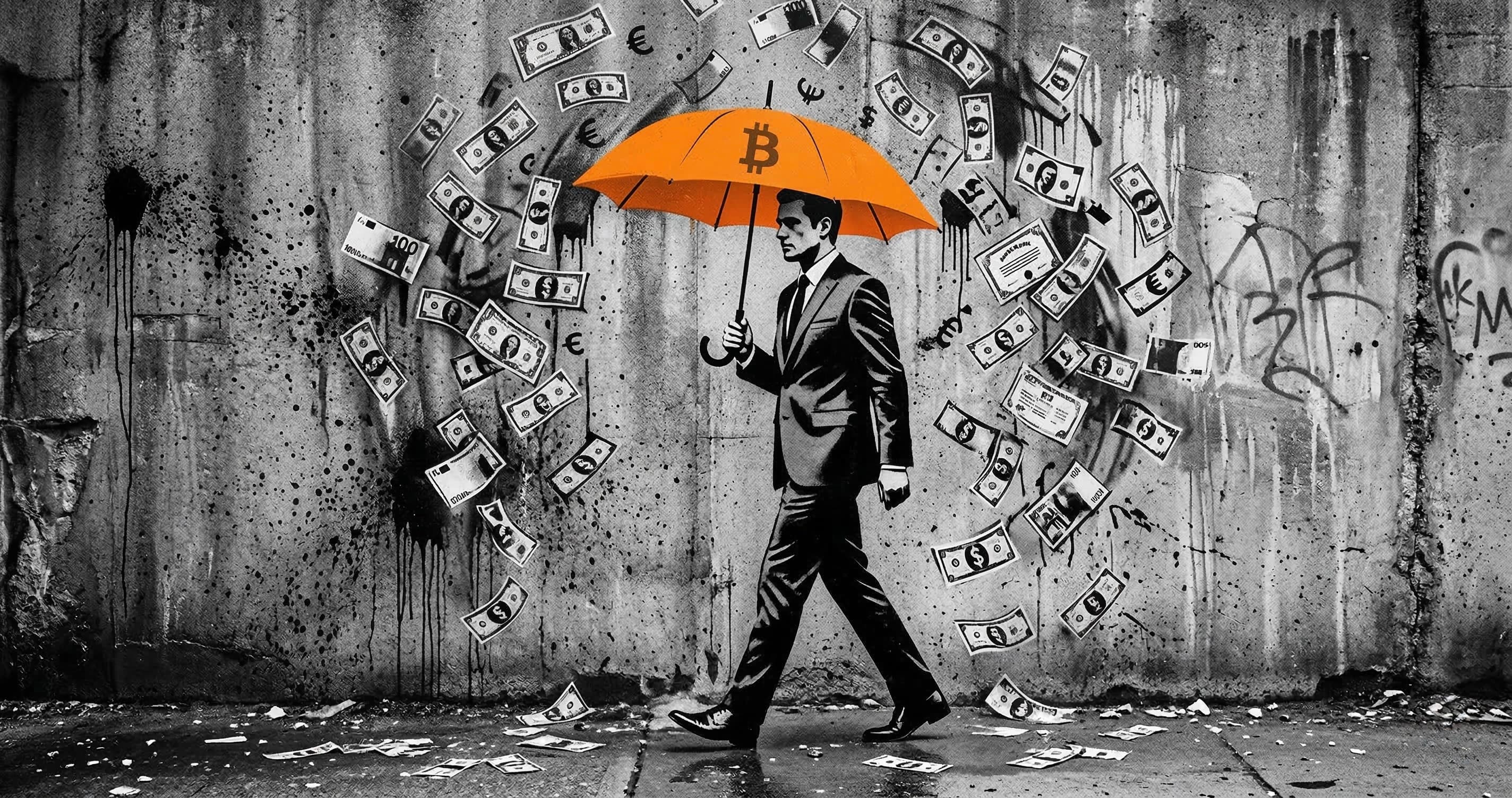
If you ask most people in finance whether Bitcoin is risky, they won’t even hesitate. Of course it is. It’s volatile. It swings 10% in a day sometimes. It trades alongside tech stocks. When markets panic, it sells off. It goes in the “risk asset” bucket and that’s the end of the conversation.
And I understand why people see it that way. If the only thing you’re looking at is price movement, Bitcoin can look risky. It dropped 50% from its all time high in the span of a few months. It can lose $10,000 in a weekend and gain it back by Wednesday. For someone used to the steadiness of a savings account or a treasury bond, that feels like chaos.
But I’ve never really seen it that way, and I think the reason comes down to how you define risk in the first place. We’ve gotten so used to equating risk with volatility that we’ve stopped asking a much more important question: what are the actual chances that this thing loses its value permanently, and why?
When you start asking that question, and you look at what Bitcoin actually is, not how it trades on a Tuesday afternoon, but what its core properties are and what they mean in a world that looks like the one we’re living in right now, you end up in a very different place than where most people start.
I think Bitcoin might be the least risky thing you can own right now. And I know how that sounds. But let me walk through why.
What Risk Actually Means
Most of the financial world defines risk as volatility. If the price moves a lot, it’s risky. If it doesn’t, it’s safe. That’s how portfolios get built, how assets get categorized, and how most people decide what to do with their money.
But that’s really a trader’s definition of risk. It makes sense if your time horizon is a quarter, or a year, or if your job depends on reporting smooth returns to clients every month. In that world, something that moves 15% in a week is a problem regardless of which direction it’s moving.
For the rest of us, though, the people trying to save money, protect our families, and make sure what we have today is still worth something in ten or twenty years, the real risk is something else entirely. The real risk is the chance that your money loses its purchasing power and doesn’t get it back. The real risk is holding an asset whose fundamental properties can be changed by someone else without your knowledge or your consent. The real risk is trusting a system that only works if the people running it keep their promises.
When you think about risk that way, volatility starts to feel like a distraction. A noisy surface on top of something much deeper. The question isn’t whether Bitcoin goes up or down 8% this week. The question is whether the thing you’re holding has properties that protect you over time, or whether it quietly bleeds value while looking stable on a chart.
Because some of the “safest” looking assets in the world are doing exactly that.
Why Bitcoin Was Built for This Moment
Bitcoin was designed with a very specific set of characteristics, and I think most people either don’t know what they are or haven’t really thought about why they matter. Especially right now.
The first one is fixed supply.
There will only ever be 21 million Bitcoin. That’s not a policy decision that some board can revisit next quarter. It’s written into the code and it has been since day one. Last week, the 20 millionth coin was mined. That means over 95% of all the Bitcoin that will ever exist is already in circulation, and the remaining million will take over a hundred years to arrive. In a world where every major government is running massive deficits and covering the gap by creating more of their own currency, an asset whose supply literally cannot be inflated is a remarkable thing. We’ve never had anything like it before.
The second is that Bitcoin has no counterparty risk.
When you hold Bitcoin in your own wallet, you don’t need a bank to custody it. You don’t need a broker to transfer it. You don’t need anyone’s permission to use it. If your bank fails tomorrow, your Bitcoin doesn’t fail with it. If your country’s payment system gets shut down, Bitcoin still works. This isn’t theoretical. We watched it happen in real time a few weeks ago when Iranian citizens moved money out of the country during airstrikes while their entire banking system was dark. The only financial network that kept working was Bitcoin.
The third is that Bitcoin is decentralized and censorship resistant.
No single person, company, or government controls Bitcoin. The rules don’t change because someone in a position of power decided they should. Compare that to the dollar, where a committee of twelve people meets eight times a year to decide what your money is worth. Or compare it to gold, where you’re trusting a vault, a government, or an ETF provider to actually hold the thing they say they’re holding on your behalf.
The fourth is that Bitcoin works everywhere, all the time, without asking anyone.
It doesn’t take weekends off. It doesn’t observe banking holidays. It doesn’t care about capital controls or international borders. When the U.S. and Israel launched airstrikes on February 28th, a Saturday, Bitcoin was the only major liquid asset on the planet that was trading. Stocks were closed. Bond markets were closed. Even gold futures were waiting for Monday. Bitcoin absorbed the shock in real time and kept going.
Lastly, Bitcoin has a completely predictable monetary policy. This is the one I think people underappreciate the most. Bitcoin’s issuance schedule was set in 2009 and hasn’t changed once. Everyone knows exactly how many new coins will be created, when they’ll be created, and at what declining rate. Try to name one other monetary system on earth where you can say that. Central banks won’t even tell you what they’re going to do at their next meeting. Bitcoin already told you what it’s going to do in 2140.
None of these properties are opinions. They’re not narratives or marketing. They’re just how the system works, and how its been working for over seventeen years. When you lay them out like that, the question of whether Bitcoin is “risky” starts to feel like the wrong question entirely.
So What’s Actually Risky?
If Bitcoin has a fixed supply that nobody can change, no counterparty risk, no central authority, and works everywhere all the time, then it’s worth turning the lens around and asking the same questions about the things most people consider safe.
Cash and government bonds. These are the bedrock of every traditional portfolio. They’re what your financial advisor calls “low risk.” But what are they, really? They’re IOUs from governments. Their value depends entirely on the discipline of central banks and politicians. The dollar has lost over 95% of its purchasing power since the Federal Reserve was created in 1913. Government debt levels are at historic highs in virtually every major economy. The United States alone is running trillion dollar deficits while simultaneously trying to fund a war, service its existing debt, and keep the economy from slowing down. The way governments have historically dealt with this kind of situation is by printing more money. Which means the thing you’re holding to be “safe” is slowly being diluted by the very institution that issued it.
Gold. Gold has been around for thousands of years and that track record means something real. I’m not dismissing it. But it comes with trade-offs that people tend to gloss over. You can’t easily send it across borders. You can’t divide it into tiny amounts and transfer it in seconds. You can’t verify your holdings without trusting a custodian, a vault, or a fund manager. Governments have confiscated it before and there’s nothing structurally preventing them from doing it again. And just a few weeks ago, during an active military conflict, the largest gold ETF in the world bled $3 billion in a single day while Bitcoin ETFs were gaining. The “safest” commodity on earth couldn’t hold its bid during exactly the kind of crisis it’s supposed to be built for.
Stocks. Over long periods of time, equities have been one of the best wealth building tools in history. But every stock comes with layers of risk that people tend to forget about when markets are going up. You’re trusting management to make good decisions. You’re trusting regulators not to change the rules. You’re trusting that the economy keeps functioning. You’re trusting that the currency your gains are denominated in holds its value. And ultimately, a share of stock is a claim on a company’s future earnings, which means it’s only as good as the system that company operates in.
The point here isn’t that these assets are bad. Plenty of people have built real wealth holding all three. The point is that every single one of them requires you to trust someone. Trust the government to be fiscally responsible. Trust the central bank to protect your purchasing power. Trust the custodian to actually have your gold. Trust the company to keep performing.
Bitcoin is the only major asset on earth that doesn’t ask you to trust anyone. It asks you to verify. And in a world where the institutions people have trusted for decades are under more pressure than they’ve been in a generation, that distinction matters more than most people realize.
The Volatility Question
I know what the pushback is, because I hear it constantly. “Okay, but it dropped 50% in a few months. How is that not risky?”
And it’s a fair question. Bitcoin fell from about $126,000 in October to around $60,000 by early February. If you put money in at the top and needed it at the bottom, you got hurt and I’m not going to pretend otherwise.
But I think it’s important to separate two things that people constantly conflate. Volatility is the price moving around a lot. Risk is the chance that your money is permanently impaired. They’re not the same thing, and treating them like they are leads to some really bad conclusions.
A savings account doesn’t move at all. It looks perfectly stable. But if it’s earning 2% while inflation is running at 3 or 4%, you’re losing purchasing power every single day. The chart looks flat. The reality is that you’re getting poorer slowly enough that you don’t notice. That’s not safety. That’s just invisible risk.
Bitcoin does the opposite. It shows you all of its risk right there on the screen, in real time, for everyone to see. It doesn’t hide anything. And yes, that makes it uncomfortable to hold sometimes. But every property we just walked through, the fixed supply, the decentralization, the censorship resistance, the predictable monetary policy, none of those changed during the drawdown. The code was the same at $60,000 as it was at $126,000. What changed was sentiment. What changed was how people felt about it on a given week.
And there’s a longer pattern worth paying attention to here. Each cycle, the drawdowns get smaller. The recoveries get faster. The base of people and institutions holding Bitcoin gets wider and more resilient. In 2011, Bitcoin dropped 93%. In 2014, it dropped 85%. In 2018, 84%. In 2022, about 77%. This cycle, so far, about 50%. The volatility is compressing over time and while it doesn’t feel like it when you’re in the middle of it, the trajectory is clear.
This is what adoption looks like for a new monetary technology. It’s just not smooth. And I think the people who understand that, who can see past the short term noise and focus on the properties underneath, are the ones who end up on the right side of this over time.
The Takeaway
We are living through a period where the things people have always assumed were safe are quietly becoming less so. Governments are spending more than they earn and printing money to cover the difference. Debt levels are at historic highs. A war is being funded in real time. Central banks are stuck between fighting inflation and keeping economies from stalling. The rules of the financial system are being rewritten on the fly, and the people rewriting them are the same ones asking you to trust that everything is going to be fine.
I’m not saying the sky is falling. Most of these institutions will probably muddle through the way they always have. But I do think it’s worth being honest about the fact that the traditional definition of “safe” is built on a lot of assumptions that are getting harder to defend.
Bitcoin doesn’t require any of those assumptions. The supply is fixed. The rules are public. The network runs regardless of who’s in power, which country is at war, or what a central bank decides to do on a Wednesday afternoon. It has been doing exactly what it was designed to do, without interruption, for over seventeen years.
That doesn’t mean it can’t go down tomorrow. It can. It probably will at some point. And if your time horizon is a few weeks, that matters. But if you’re thinking in years and decades, which is how most people should be thinking about their savings, then the question isn’t whether Bitcoin is volatile. The question is whether the properties it has make it more or less likely to preserve and grow your purchasing power over time compared to the alternatives.
Every characteristic points in one direction. Fixed supply in a world of unlimited printing. No counterparty risk in a world of institutional fragility. Censorship resistance in a world of increasing financial controls. Predictable rules in a world where the rules keep changing.
I know it still sounds strange to call Bitcoin the least risky thing you can own. But I think in five or ten years, it won’t sound strange at all. It’ll sound obvious. And the people who figured it out now, while it still felt uncomfortable, will be glad they did.