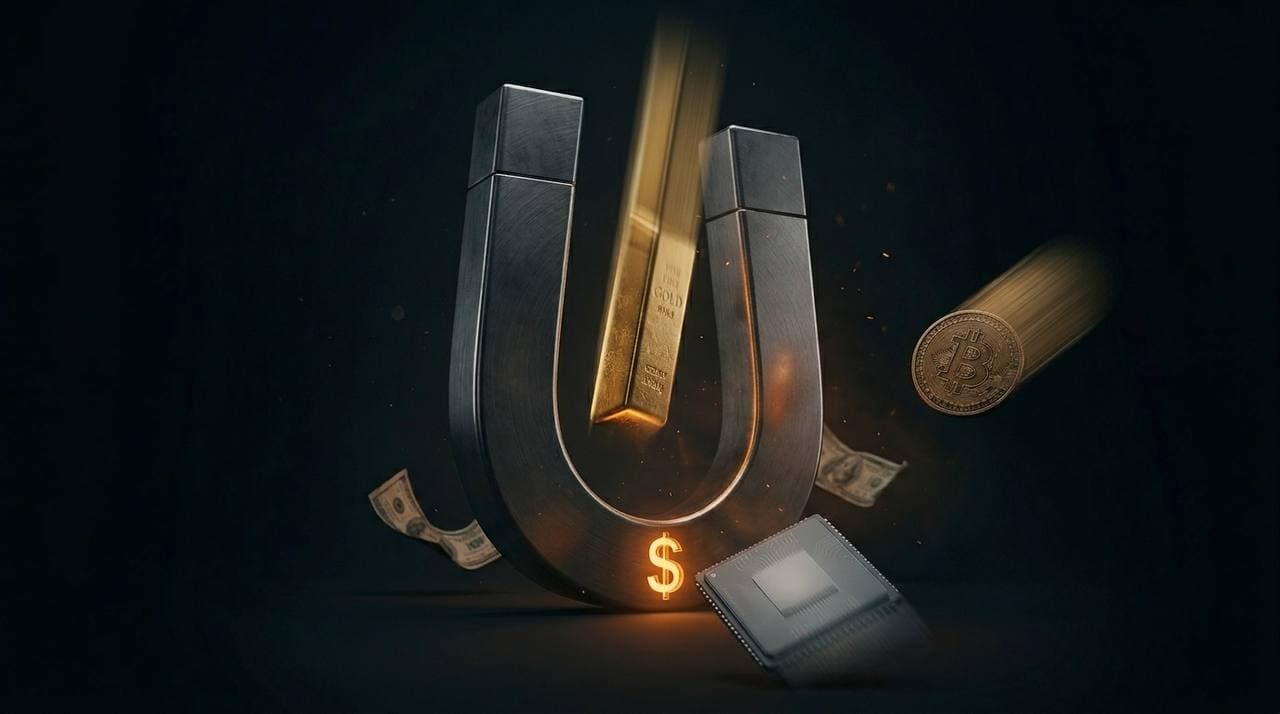
Here's a strange week. If you keep some gold and some Bitcoin, you're not really making two bets. You're making one. Both are scarce, neither answers to a government, and you hold them for the same reason: a quiet worry that the people who print the dollar will keep printing until each one buys less. Call it the bet against the dollar.
This week that bet lost, and it lost in the most backwards way possible. The one thing going up was the dollar itself, the very thing you hold gold and Bitcoin to protect yourself from. Gold dropped below $4,000 and Bitcoin slid again.
However, I think there was one major story this week, and it's simple. What you watched wasn't a handful of things breaking. It was money itself getting scarce for a moment, and when money gets scarce, everything else goes on sale at once.
Why Everything Fell on the Same Day
That sameness is the first clue, and a fair skeptic will turn it against me. If gold and Bitcoin are really a similar bet, then the two of them falling together proves almost nothing. It just looks like the hard-money trade had a bad day.
So that can't be the evidence. The evidence is what fell beside them. That same week, the AI stocks got hammered, one of their ugliest stretches in months. Nvidia and the chipmakers dropped hard, the tech-heavy Nasdaq fell more than 3% in a day, and the chip names shed close to a tenth of their value. The AI trade is the opposite kind of animal from Bitcoin. It's the hot, crowded, momentum bet of the moment, the thing people pile into because everyone else is. Bitcoin is the slow, stubborn bet rooted in the math of a fixed supply. They have different crowds and different reasons.
Yet they fell on the same day because they were hit by the same hammer. The reason for the crash was that the Fed had signaled interest rates will stay high. That is the very same reason the dollar got stronger and gold and Bitcoin got sold. One force knocked all of them down at once. When the wild speculative bet and the careful fundamental bet drop together, you don't have a story about either bet. You have a story about the thing underneath both, which is the dollar.
So why did the dollar suddenly get expensive? Not because anyone made fewer of them, but because everyone wanted them at once. A dollar isn't dead money. Park it in the bank and it pays you interest, right now around 4 or 5 percent, for no risk at all. Gold pays nothing. Bitcoin pays nothing. They're bets on the future, not income today. So when the Fed signals that high interest is here to stay, every investor asks the same question: why sit in something paying zero when cash pays five and the Fed just promised to keep it there? Money floods out of the things that pay nothing and into the dollar. That flood is the dollar getting stronger and everything else getting cheaper, in the same motion.
However, there's an uncomfortable truth. In a panic, the market can't tell the speculative thing from the fundamental thing. It dumped Bitcoin in the same breath as the frothiest AI stock, as if it were just another chip to cash in, even though one is held up by a crowd that can change its mind overnight and the other by a supply cap that no crowd, no company, and no central bank can vote to change.
Bitcoin fell harder than gold for that same reason: it's the most liquid hedge there is, the easiest thing to sell at three in the morning when what you need is cash. Falling hardest didn't make it the most broken. It made it the closest thing to cash in a room where everyone suddenly wanted cash.
The Borrowed Bet Always Breaks First
There's a smaller story from this month that makes the whole thing click. A company called Strategy, which most people still know as MicroStrategy, has spent years buying Bitcoin and loudly promising never to sell a single coin. This month, it sold some. They sold thirty-two coins and the headlines went wild saying that their model and bet is broken.
What they left out though is that the company owns more than 840,000 Bitcoin, and it sold thirty-two of them to cover a payment it owed its investors. So it wasn't like they were bolting for the exit, but rather that they were reaching into their pocket for the easiest cash it had to pay a bill. Thirty-two coins out of eight hundred and forty thousand is a rounding error, not a surrender.
But it teaches the real lesson of a week like this. There's a difference between owning something and owning something with debt stacked on top of it. That company didn't just buy Bitcoin. It borrowed and made promises to investors so it could buy more, and those promises come due in dollars on fixed dates no matter what the price is doing. So when cash got tight, the bill arrived and it had to sell a little to pay it. The person who simply bought Bitcoin and held it had no bill, no deadline, and did nothing at all this week. Same asset, completely different week. When money gets scarce, the borrowed version of any bet is the first to crack, and people watching from outside mistake the borrowing breaking for the thing itself breaking. I wrote more about that trap in the leverage problem nobody wants.
Cash Is Winning This Week. It Won't Win the Decade.
So the real winner this week was cash. And holding cash feels great right now, because the bank pays you to sit there and do nothing. Why hold anything risky when safe money pays you to wait?
Because the very thing that makes cash pay so well is the thing quietly breaking the system underneath it. High interest rates are wonderful if you're a saver and brutal if you're a borrower, and the world runs on borrowers. Out past the ordinary banks sits a giant pile of loans, trillions of dollars of it, lent to companies that now have to pay far more to carry their debt. The cracks are showing. More and more of those borrowers can't cover the interest in cash, so they're being allowed to pay it with even more borrowing, which is the financial version of paying one credit card with another. It works right up until it doesn't.
And the biggest borrower on earth is the government, which owes $39 trillion. At these interest rates that bill gets heavier every single year. So we're in a strange spot: the high rates that make cash so attractive are the same rates the government and a whole world of borrowers cannot survive for long. Something has to give. And when it does, the people in charge will reach for the tool they always reach for, pushing rates back down and creating new money to smooth over the cracks. I walked through why there's genuinely no other way out last week in why saving cash is a losing game right now.
Which brings it back to gold and Bitcoin, the two halves of that same bet against the dollar. They run on identical logic: when governments keep making more money, you want to hold something they can't make more of. The difference is that gold has a small leak. When the price climbs, miners dig a little faster, and the supply still creeps up a percent or two every year. Bitcoin has no leak. Its supply is capped in the software at twenty-one million coins, and no miner, no company, and no central bank can vote to add a single one. This week's scramble for dollars will fade, the way every squeeze does. The $39 trillion won't, and neither will the new money eventually printed against it. That is the whole case for owning the one thing with no leak at all.
What I'm Watching
None of what I'm watching is the day-to-day price. I'm watching those cracks in the world of borrowers, the companies paying their interest with more debt instead of cash. That's the quiet signal that the high-rate world is running out of road, and it shows up long before it reaches the front page.
I'm watching the dollar itself, because as long as it keeps getting stronger the pressure stays on everything priced against it, Bitcoin included, and the day the dollar turns is the day the tide comes back in. And I'm watching whether the same big investors who sold this week come back when money loosens up, because they always do, and they always do it after the turn, not before.
I don't know what Bitcoin does next month, and I've never pretended to. What I know is that this week wasn't a verdict on Bitcoin, or gold, or the AI boom. It was a verdict on the dollar, and for one week the verdict was that dollars were scarce. That's a temporary condition by design, because the people who run the dollar have 39 trillion reasons to make it plentiful again. So I'm not doing anything clever. I'm not selling something I believe in because the borrowed bets around it wobbled and a panic mistook it for a tech stock. I'm doing the same boring thing I always do, buying a little on a schedule and ignoring the noise, still dollar-cost averaging.